- By electricmobilityafrica
- September 28, 2026
- Innovation
- 0 Comments
ARC Ride Expands to Ghana: What the Kenyan Electric Mobility Company Brings to the Market
Electric motorcycles are becoming increasingly visible on African roads, but one of the biggest challenges is not necessarily the motorcycle itself. It is the battery.
For riders who depend on their motorcycles for deliveries, transport and daily income, waiting for a battery to charge can mean time away from the road. This is one of the problems ARC Ride is trying to address with a model built around electric motorcycles, battery swapping and a network of swap stations.
The company, which has operated in Kenya for several years, has now expanded into Ghana, bringing with it a system that goes beyond simply selling electric motorcycles.
From Kenya to Ghana
ARC Ride, also known as ARC Ride Africa, began its operations in Kenya with a focus on electric motorcycles for commercial and delivery riders.
Kenya has become one of Africa’s more active markets for electric two-wheelers, partly because motorcycles are widely used for transportation and delivery. This gives companies such as ARC Ride a large potential market for electrification.
Rather than expecting riders to wait for their motorcycles to charge, ARC Ride developed a battery-swapping model.
The idea is relatively simple.
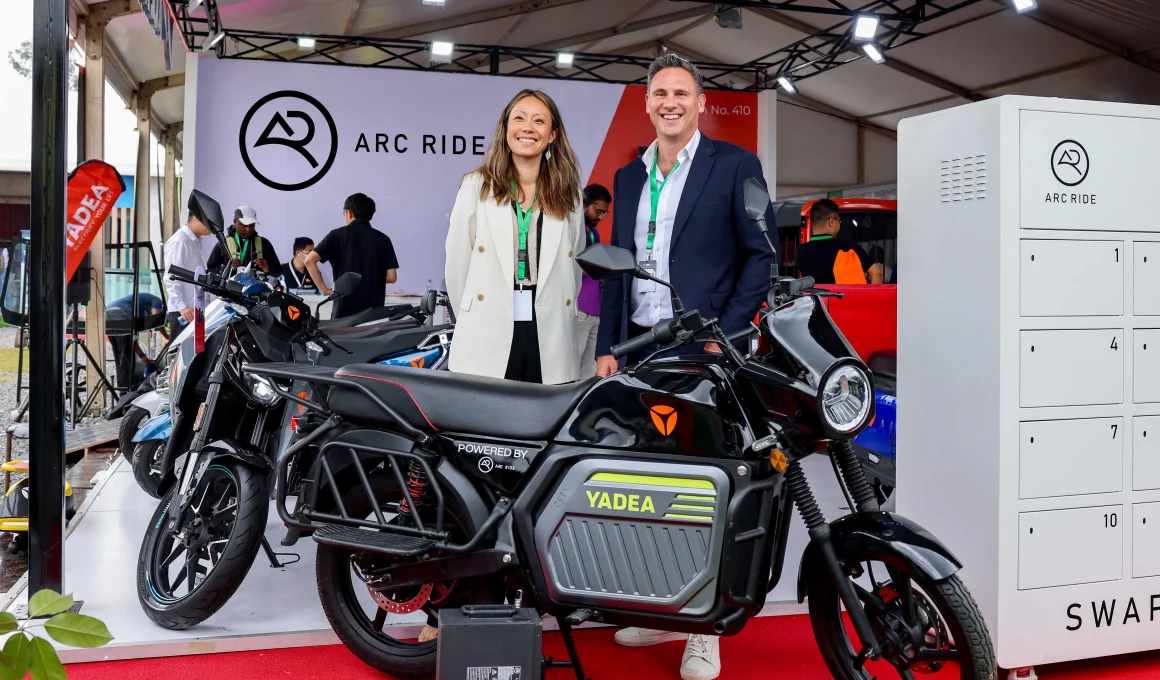
A rider arrives at a swap station with a depleted battery, removes it and exchanges it for a charged battery. The depleted battery is then charged at the station and becomes available for another rider.
Instead of waiting for the battery to charge, the rider can continue working.
That difference is particularly relevant for commercial riders, where time spent charging can directly affect income.
The battery is part of the system
One of the more interesting parts of ARC Ride’s model is that the battery is not treated simply as something the rider buys and owns.
The company’s model is built around Battery-as-a-Service, where riders can access batteries through the company’s swapping network.
This changes the economics of owning an electric motorcycle.
A conventional electric motorcycle requires the owner to think about the motorcycle and its battery as one purchase. With a battery-swapping system, the rider can potentially separate the cost of the motorcycle from access to the energy needed to operate it.
It also means ARC Ride has an interest in building infrastructure around its motorcycles.
The motorcycle, battery, charging station and software become parts of one ecosystem.
How the swapping system works
The process is designed around speed.
A rider arrives at a swap station and presents the depleted battery. The station provides access to a charged battery, which the rider installs on the motorcycle.
The depleted battery is then connected to the charging system.
This means the rider doesn’t have to wait for a full charging cycle.
For someone using a motorcycle commercially, that can be significant.
A delivery rider who spends several hours on the road cannot necessarily afford to stop for long periods to recharge. A swap can reduce that interruption to a much shorter stop.
The usefulness of the model, however, depends heavily on one thing:
There must be enough swap stations in the places riders actually need them.
A battery-swapping network only becomes convenient when riders can reliably find another station before their battery runs out.
That makes infrastructure just as important as the motorcycle.
ARC Ride’s model in Ghana
ARC Ride has now started establishing its presence in Ghana, with battery-swapping stations appearing in Accra.
The company’s arrival comes as Ghana’s electric mobility market is beginning to expand beyond electric cars.
Electric motorcycles could have particular relevance in Ghana because motorcycles are increasingly used for delivery, logistics and commercial transportation.
For riders who spend most of their working day on the road, the economics of an electric motorcycle can be different from those of a private passenger vehicle.
Fuel is replaced by electricity, while maintenance requirements can also differ because electric drivetrains generally contain fewer moving parts than internal-combustion engines.
But the biggest question for Ghana may not be whether electric motorcycles can work.
It may be whether the infrastructure can grow quickly enough to support them.
Why battery swapping could matter in Ghana
Charging infrastructure for electric cars is already developing in Ghana, but motorcycles create a slightly different requirement.
A private EV owner might be able to charge at home overnight.
A commercial motorcycle rider may not have that luxury.
They need their vehicle available for long periods and may travel continuously throughout the day.
Battery swapping addresses this particular use case.
Instead of asking:
“Where can I leave my motorcycle for several hours to charge?”
the question becomes:
“Where is the nearest battery-swap station?”
That could make electric motorcycles more practical for high-mileage users.
It could also create a new infrastructure business around batteries.
But the model has challenges
Battery swapping is not automatically successful simply because the technology works.
The network has to be dense enough.
There have to be enough charged batteries available.
The batteries need to be compatible with the motorcycles using the network.
Stations need reliable electricity.
And riders need to find the cost of swapping competitive with what they currently spend on fuel.
There is also the question of scale.
A few swap stations in Accra may demonstrate the concept, but a commercial rider needs to know that the network will continue to expand as their daily routes expand.
That is why ARC Ride’s move into Ghana will be worth watching beyond the motorcycles themselves.
The company’s real test may be whether it can build a sufficiently large energy and infrastructure network around them.
More than an electric motorcycle company
This is perhaps the most interesting part of ARC Ride’s model.
It is easy to look at an electric motorcycle company and see a company selling motorcycles.
But a battery-swapping company is doing something different.
It is building an energy network around transportation.
The motorcycle is one part.
The battery is another.
The swap station is another.
Then there is the software, maintenance, battery management and rider network connecting everything together.
That model could eventually extend beyond one motorcycle manufacturer if the infrastructure and technology develop in that direction.
For Ghana, that could create opportunities not only for electric motorcycles but also for businesses involved in energy, charging infrastructure, battery management, maintenance and mobility services.
What comes next?
ARC Ride’s expansion into Ghana comes at an interesting time for the country’s mobility sector.
Ghana is developing its national electric vehicle policy, charging infrastructure is gradually increasing and more companies are experimenting with electric cars, motorcycles and other forms of electric transport.
The challenge now is moving from individual products to an ecosystem.
An electric motorcycle is useful only if its rider can access energy conveniently.
A charging station is useful only if there are enough EVs using it.
And EV adoption becomes easier when financing, maintenance, insurance, infrastructure and energy services develop alongside the vehicles.
ARC Ride’s model brings all of these questions together.
Its progress in Ghana will therefore be about more than how many motorcycles it puts on the road.
It will also show whether battery swapping can become a practical part of Ghana’s commercial transport system.
For riders, the proposition is straightforward: less time waiting to charge and more time on the road.
For the wider mobility industry, the bigger question is whether Ghana can build the infrastructure needed to make that proposition work at scale.